Without failing.
Without training over and over and over again.
Without building yourself through smaller distances first.
Without enduring.
That’s the part people don’t want to hear.
The finish line is romanticized.
The training is what actually matters.
The start line isn’t where confidence is built. Confidence is built in the repetitions nobody sees.
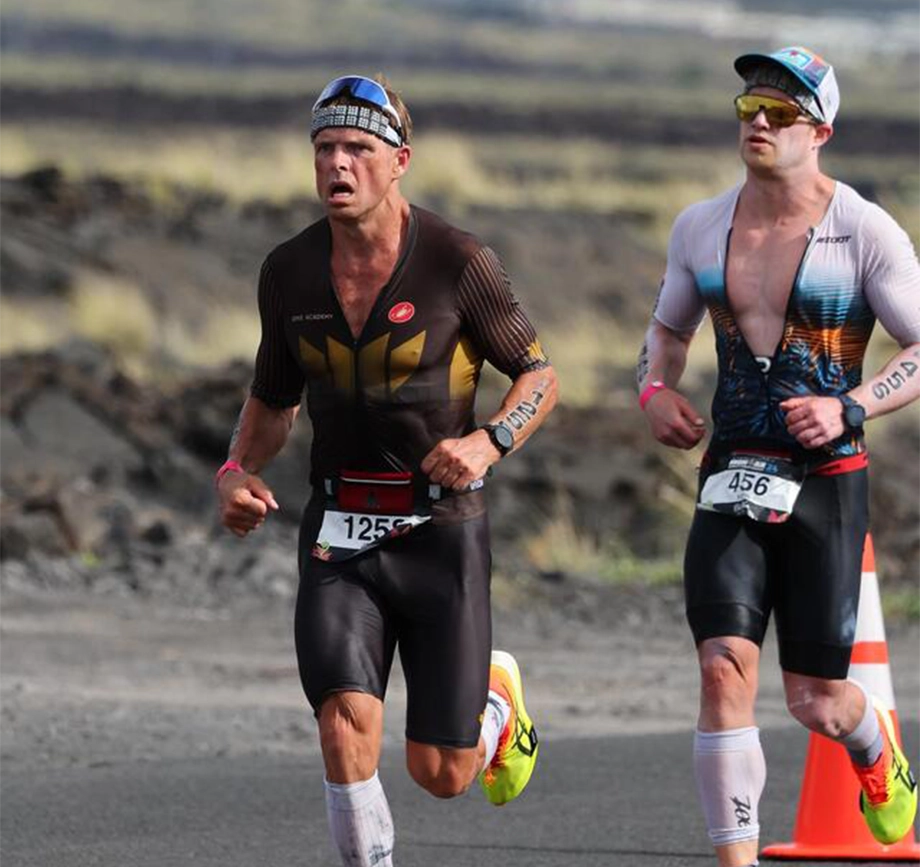
By the time I stood on the start line in Kona for the Ironman World Championships, I was nervous as hell.
But I had done the work.
I had stacked 20+ hour training weeks.
I rode 4–6 hours through the hottest parts of summer.
I ran in the heat.
I swam in pools, lakes, wherever I could.
I raced shorter events.
I practiced suffering.
I practiced continuing.
That’s what gave me confidence.
Not fake toughness.
Not pretending I was fearless.
Repetition.
Experience.
Resilience.
It wasn’t toughness that got me through what I consider one of the best races of my life.
Well… maybe a little bit.
But mostly, it was resilience built from four years of training for that moment.
Ten years of OCR, trail, road racing, and endurance sport before that.
And honestly, probably fifteen years of surviving the personal hell I created long before sport ever entered my life.
People think endurance athletes are fearless.
Most of us aren’t.
We’ve just learned that fear, discomfort, exhaustion, doubt, and suffering don’t automatically mean stop.
That lesson is earned.
Not born.
I remember when I first started cross country.
I would lie awake the entire night before races.
I wanted to do well so badly, and I also knew how much it was going to hurt.
Back then, pain scared me.
Now?
The pressure is different.
I don’t stand on start lines needing to prove myself anymore.
I stand there wanting to know I gave absolutely everything I had.
If I don’t win?
If I don’t place top 10 or top 20?
Fine.
As long as I emptied the tank.
And strangely enough, I don’t fear the pain anymore.
I almost look forward to it.
I know that sounds insane to people outside endurance sports.
But after enough repetitions, suffering becomes familiar.
I know the feeling of blood in my throat.
I know what happens when my vision narrows.
I know the moment my brain tells me to slow down.
I know what my body is capable of because I’ve visited that place over and over again.
That’s not mental toughness.
That’s adaptation.
That’s experience.
That’s earned resilience.
Anyone can drag themselves through a race without training.
But the real victory?
It’s in the sessions nobody sees.
The freezing early mornings.
The solo workouts.
The long rides in the heat.
The intervals you wanted to quit halfway through.
The sessions where nobody was clapping for you.
The boring repetitions stacked week after week after week.
That’s where endurance is built.
That’s what carries you when things get dark during a race.
Because when things get hard, your brain doesn’t magically become tougher.
It remembers.
It remembers all the times you survived this feeling before.
And the best part?
Nobody is born with it.
Not me.
Not the pros.
Not the people you look up to.
Resilience is trainable.
You build it the same way you build endurance, strength, or confidence:
One repetition at a time.